

Block Party: Your Guide to Finding Retaining Wall Blocks for Sale
Where to Find Retaining Wall Blocks Near Me (And What to Look For)
If you’re searching for retaining wall blocks near me, here’s a quick answer to get you started:
Where to buy retaining wall blocks locally:
- Home improvement stores (The Home Depot, Lowe’s) — standard concrete blocks starting around $1.78–$6.47 per unit, available for same-day pickup
- Local landscape supply yards — wider selection, pallet pricing, and contractor bulk discounts
- Specialty hardscape distributors (SiteOne, local dealers) — premium brands like Belgard, Techo-Bloc, Unilock, and Versa-Lok
- Local garden centers — smaller selections but often with knowledgeable staff and delivery options
Quick cost reference:
| Block Type | Approx. Cost Per Unit | Bulk Discount Threshold |
|---|---|---|
| Mini concrete block (3 in.) | $1.78–$1.97 | 378+ units |
| Standard concrete block (4 in.) | ~$2.57 | 144+ units |
| Large concrete block (6 in.) | ~$6.47 | 48+ units |
| Premium (Versa-Lok, Unilock) | $7.75–$11.10 | Pallet pricing |
Here in the Salt Lake Valley, a sloped yard isn’t just an eyesore — it’s a real problem. Erosion eats away at topsoil, water runoff can threaten your foundation, and steep grades make your outdoor space practically unusable.
A retaining wall fixes all of that. And the first step is finding the right blocks.
The challenge? There are dozens of block types, brands, sizes, and price points out there. Walk into a big-box store and you’ll find 15 options. Check a specialty distributor like SiteOne and suddenly there are over 110 products to sort through.
This guide cuts through the noise. Whether you’re a DIY homeowner building a small garden wall or a contractor pricing out a full slope-retention project, you’ll know exactly what to look for — and where to find it.
Types of Retaining Wall Blocks Near Me
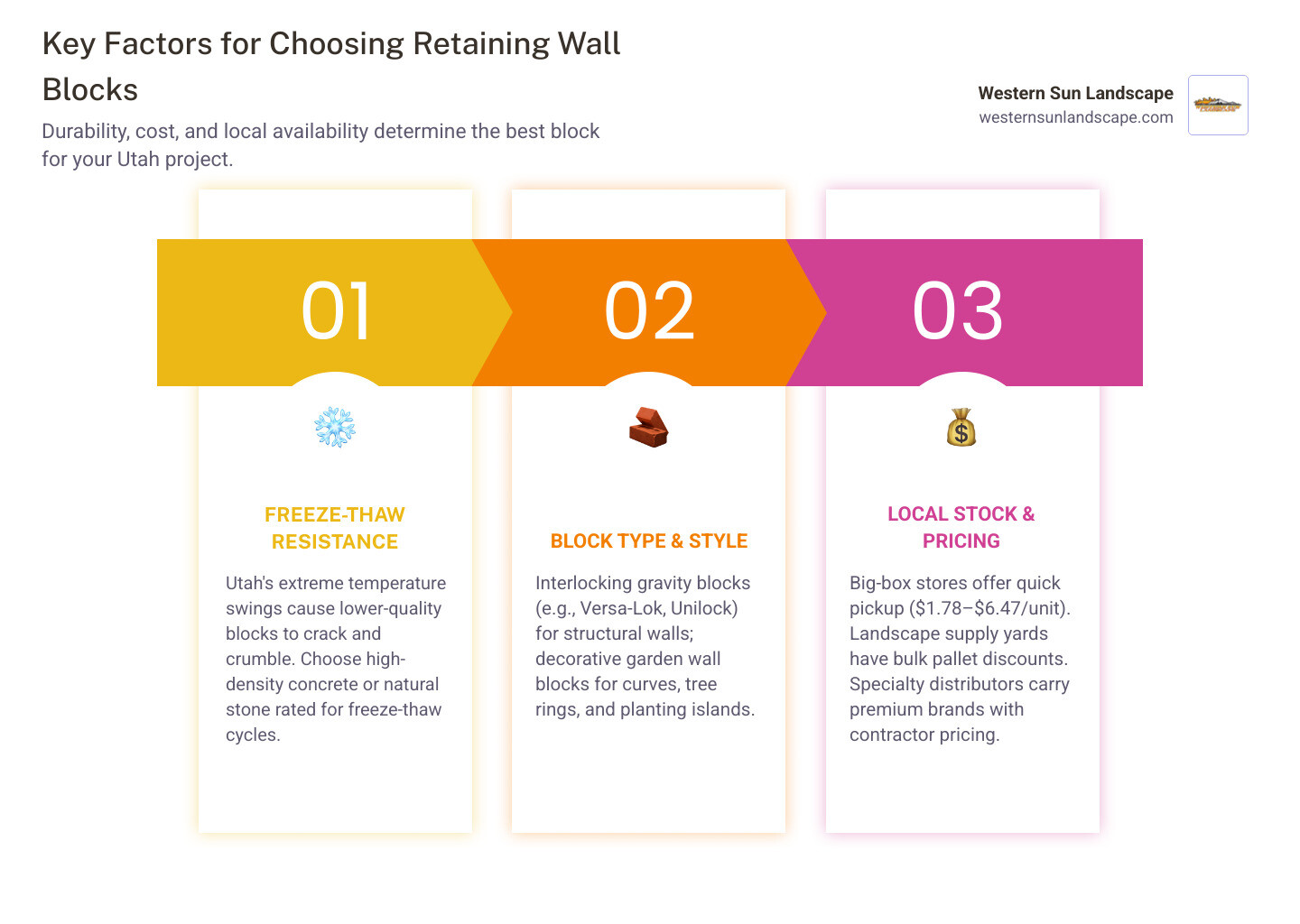
Choosing high-quality hardscape materials for durability is the most critical decision of your project. In Utah’s harsh climate—where temperatures swing from blistering summer heat to freezing winter nights—your blocks must withstand intense freeze-thaw cycles. Lower-quality materials will crack, flake, and crumble under the pressure of expanding frozen soil.
Manufactured concrete blocks dominate the market because they are engineered to meet strict structural standards. However, you also have natural stone and specialized dimensional stone options to consider.
- Concrete Blocks: These are the workhorses of residential landscaping. They are highly standardized, incredibly durable, and come in a massive variety of colors (such as pewter, buff, river red, and charcoal).
- Natural Stone: If you want a classic, rustic look, natural stone is unmatched. From rugged fieldstone to weathered quarry slabs, these materials are sold by the pallet and sorted by shape and thickness.
- Dimensional Stone: This premium option offers the best of both worlds. Dimensional blocks, like the retaining wall blocks from Mr. Mulch, are manufactured to have a tumbled, natural look but with consistent dimensions that make them much easier to stack than raw stone.
Interlocking Retaining Wall Blocks
For structural stability and erosion control, interlocking block systems are the gold standard. Instead of relying on mortar, these systems use clever physical mechanisms to lock the blocks together.
- Rear Lip Design: Many standard blocks, like the Oldcastle Sandy Shores concrete block, feature a built-in lip along the back bottom edge. As you stack the blocks, this lip hooks over the course below, automatically aligning the wall and creating a slight, structurally secure backward lean (known as “batter”).
- Pin Systems: Premium systems use high-strength fiberglass pins or dowels to connect courses. For example, the Versa-Lok block system features a unique hole-to-slot pinning system. Because these blocks are solid concrete with no hollow voids to fill, they can be easily modified on-site to create custom angles, curves, and steps.
- Tongue-and-Groove: Other systems use molded ridges and grooves that slide together, ensuring the blocks cannot shift forward or backward under the weight of the soil behind them.
Decorative Garden Wall Blocks
If you are building a low-profile feature—like a decorative garden border, a tree ring, or raised planting islands—heavy-duty structural blocks might be overkill.
Decorative garden wall blocks are lighter, easier to handle, and designed with aesthetics in mind. They typically feature standard garden wall block dimensions (such as 3 or 4 inches in height) and are available in a beautiful array of color options.
Tapered blocks are particularly useful for decorative projects. Because they are wider in the front than in the back, you can easily curve them to create elegant circles, winding garden paths, and soft backyard borders without having to cut a single block.
How to Choose and Calculate Blocks for Your Project
Before you head out to buy materials, you need to understand how blocks are measured and sold.
While you can purchase standard blocks individually at big-box stores, larger projects require purchasing by the pallet. In the hardscaping industry, pallet quantities are often measured in face feet (the square footage of the front face of the wall) rather than just a raw block count. A standard pallet of heavy-duty blocks typically covers between 24 and 32.3 face feet of wall surface.
| Block System | Nominal Dimensions (H x W x D) | Approx. Weight per Block | Pallet Coverage | Best Use Case |
|---|---|---|---|---|
| Mini Garden Block | 3″ x 8″ x 4″ | ~8 lbs | N/A (Sold per piece) | Tree rings, borders under 12″ |
| Standard Interlocking | 4″ x 11.75″ x 6.75″ | ~23 lbs | ~30 sq. ft. | Terraced beds, walls under 24″ |
| Versa-Lok Standard | 6″ x 16″ x 12″ | ~82 lbs | ~32 sq. ft. | Heavy soil retention, walls up to 4′ |
| Brussels Dimensional | 4″ x 12″ x 8″ | ~28 lbs | ~24 sq. ft. | Outdoor kitchens, pillars, garden walls |
Choosing the right block depends entirely on your project’s scale. For a deep dive into matching the right system to your yard’s topography, check out our guide on choosing the best earth retaining systems for your next big project.
Sizing and Style Considerations
Your block selection should complement the architectural style of your home. To achieve this, pay close attention to the nominal dimensions, textures, and color palettes of the blocks:
- Split Face: This texture features a rough, fractured concrete face that mimics the natural look of broken stone. It is perfect for traditional, rustic, or rugged landscape designs.
- Tumbled Texture: These blocks undergo a weathering process that rounds off sharp edges, creating an antiqued, historic look. The tumbled design of blocks like Brussels Dimensional makes them incredibly forgiving to handle and cut.
- Smooth Finish: Boasting clean lines and crisp angles, smooth-faced units are ideal for modern, minimalist, and contemporary outdoor living spaces.
Always try to view physical samples in person at a local supply yard before ordering. Digital catalog images can look vastly different under the bright Utah sun.
Calculating Your Material Needs
To avoid mid-project trips to the store (or ending up with a mountain of leftover concrete), use this step-by-step calculation method:
- Measure the Length: Determine the total linear footage of the wall.
- Measure the Height: Determine the planned height of the wall (including the buried base course).
- Calculate Face Square Footage: Multiply the length by the height.
- Convert to Blocks: Divide your total face square footage by the face square footage of a single block. (For example, a standard 4″ x 12″ block covers 0.33 square feet).
- Add a Waste Factor: Always add 5% to 10% to your total for cutting, corner adjustments, and accidental breakage.
- Account for Specialty Units: Don’t forget to calculate your base blocks (which establish a level foundation), capstones (which finish and protect the top of the wall), and corner units (which ensure strong, clean 90-degree angles).
Cost Factors and Sourcing Materials
When planning your budget, the cost of your blocks is only one piece of the puzzle. You also need to account for base gravel, drainage pipe, filter fabric, high-strength concrete adhesive, and delivery fees.

Understanding hardscape material supplier pricing is key to optimizing your budget. Here is what influences the bottom line:
- Material and Brand: Standard retail blocks from brands like Pavestone or Oldcastle are highly economical. Premium, engineered systems from Belgard, Unilock, or Versa-Lok cost more upfront but offer superior longevity, advanced interlocking mechanisms, and richer color blends.
- Unit vs. Pallet Pricing: Buying individual blocks is perfect for small repairs or tree rings, but it is the most expensive way to purchase. Buying by the pallet unlocks bulk wholesale discounts—often saving you 10% or more once you cross specific volume thresholds.
- Pallet Deposits: Be aware that premium manufacturers like Unilock ship their blocks on specialized pallets. Suppliers charge a refundable deposit (often around $20–$30 per pallet) that is refunded once you return the empty pallets to the yard.
Sourcing Retaining Wall Blocks Near Me Locally
Finding the right supplier depends on the size of your project and how you plan to transport the materials.
For small DIY projects, local home improvement stores in South Jordan, Sandy, or West Jordan are incredibly convenient. They allow for easy in-store pickup, and you can easily load a dozen standard blocks into the back of an SUV.
However, concrete is incredibly heavy. A single pallet of standard retaining wall blocks can weigh anywhere from 2,000 to 3,000 pounds. Unless you own a heavy-duty truck and trailer, you will want to utilize professional delivery services.
Most local supply yards offer flat-rate delivery, utilizing specialized flatbed trucks equipped with forklift attachments to place the pallets precisely where you need them on your property. If you are looking at regional supply options to compare styles, you can browse catalogs like the retaining wall products at Johns Building Supply in Massachusetts, but for local delivery and service along the Wasatch Front, working with a local Utah supplier is essential.
Finding Retaining Wall Blocks Near Me in Stock
Before you start excavating, always verify local inventory. Hardscaping is highly seasonal, and popular block colors can sell out quickly during the peak spring and summer landscaping months.
Many suppliers allow you to check live inventory online to ensure they have enough matching dye-lot blocks in stock. If your project requires specialty colors or unique shapes, you may need to place a bulk order several weeks in advance.
Installation and Drainage Best Practices
A retaining wall is a major structural element. It has one job: hold back thousands of pounds of wet, heavy soil. If it isn’t built correctly, gravity and water will eventually win, causing the wall to bow, lean, or completely collapse.
To prevent soil erosion and structural failure, you must manage water runoff. Water is the number one enemy of retaining walls. When rain falls or snow melts along the Wasatch Front, water sinks into the soil behind your wall. If that water has nowhere to go, it creates immense hydrostatic pressure.
To build a wall that lasts for decades, follow these non-negotiable best practices:
- Dig a Proper Trench: Your wall is only as stable as its foundation. You must excavate a trench deep enough to accommodate a compacted gravel base and at least one fully buried course of blocks.
- Create a Level Gravel Base: Never place blocks directly on dirt. Use 4 to 6 inches of compacted angular gravel to distribute weight evenly and prevent settling.
- Install a Perforated Drain Pipe: Place a perforated drain tile (weep pipe) at the very bottom of the wall behind the first course of blocks. This pipe must slope downward to redirect water away from the wall.
- Backfill with Clean Gravel: Fill the space directly behind the blocks (at least 12 inches deep) with clean, angular gravel. This allows water to quickly trick down to the drain pipe rather than pressing against the back of the blocks.
- Use Filter Fabric: Place landscape fabric between the gravel backfill and the natural soil to prevent fine dirt from clogging your drainage system.
- Secure with Adhesive: Use high-strength concrete adhesive to secure the top capstones and any corner units to prevent them from shifting when stepped on.
For a comprehensive overview of how these elements work together, read our guide on retaining walls.
DIY vs. Professional Installation
Can you build a retaining wall yourself, or should you hire a professional?
If your planned wall is under 3 to 4 feet tall, it is a highly feasible DIY project. It will require a lot of physical labor—shoveling gravel, lifting heavy blocks, and meticulously leveling each course—but with patience, a homeowner can build a beautiful, lasting garden wall.
However, if your wall is over 4 feet tall, DIY is no longer an option. Walls of this height are subject to immense structural loads and require:
- Geogrid Reinforcement: High-strength grid fabric layered between courses to tie the block wall back into the soil behind it.
- Engineering Plans: Detailed structural calculations to ensure the wall can handle the soil load.
- Permits: Most municipalities along the Wasatch Front require building permits and professional inspections for walls over 4 feet.
If your property features steep slopes, complex terracing, or requires structural engineering, it is always best to partner with professional contractors who understand Utah’s specific clay soils and municipal codes. You can learn more about how we handle these complex projects by exploring our full range of landscaping services.
Frequently Asked Questions about Retaining Wall Blocks
How much do retaining wall blocks typically cost?
On average, standard concrete retaining wall blocks cost between $2.50 and $6.50 per unit. Small 3-inch decorative border blocks can cost as little as $1.78 each, while premium, solid-unit structural blocks like Versa-Lok or Unilock Brussels Dimensional range from $7.75 to $11.10 per block. When purchasing by the pallet, expect to pay between $450 and $1,050 depending on the brand, block size, and coverage area (typically 24 to 32 square face feet).
Do I need a permit to build a retaining wall?
In most Utah municipalities—including South Jordan, Sandy, and Salt Lake City—you do not need a building permit for retaining walls that are under 4 feet in total height (measured from the bottom of the buried base course to the top of the wall). However, any wall 4 feet or taller, or any wall supporting a surcharge (such as a driveway, slope, or fence at the top), requires a building permit, engineering plans, and professional installation to ensure safety standards are met.
What is the difference between gravity walls and reinforced walls?
A gravity wall relies entirely on its own weight and setback (backward lean) to hold back the soil. Gravity walls are typically limited to under 4 feet in height. A reinforced wall uses layers of geogrid (a high-strength geogrid mesh) sandwiched between the blocks and extended deep into the soil behind the wall. This ties the blocks and the soil together into a single, massive cohesive mass, allowing for the construction of much taller, structurally sound walls.
Conclusion
Finding the perfect retaining wall blocks near me is the first step toward transforming your yard from a sloped, eroding headache into a beautiful, functional outdoor living space. Whether you are laying down a simple stone border around a cherry tree or planning a major terraced backyard overhaul, selecting the right materials and prioritizing proper drainage is key to a wall that stands the test of time.
At Western Sun Landscape, we bring over 45 years of local Utah expertise and a proud 4.9-star Google rating to every project we touch. We know the unique challenges of landscaping along the Wasatch Front—from the clay soils of Herriman and Riverton to the steep mountain slopes of Draper and Alpine.
If you are ready to elevate your property with professional landscape design installation or need expert help constructing durable retaining walls, we are here to help.
Contact us today to schedule a consultation, and let’s build something beautiful together!


