

How to Handle Rental Property Lawn Care Without Losing Your Mind
Landlord Lawn Maintenance Starts With a Clear Written Plan
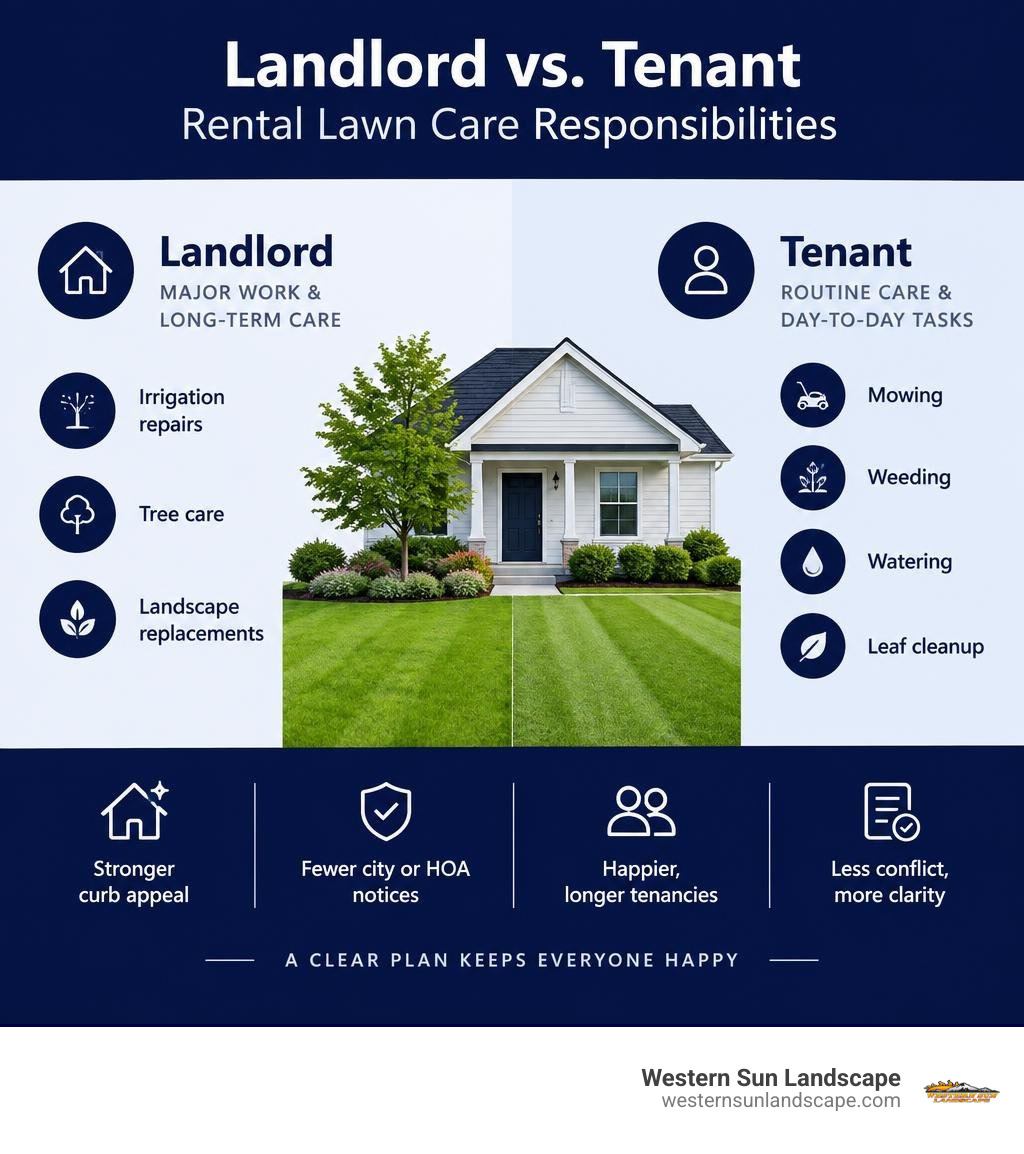
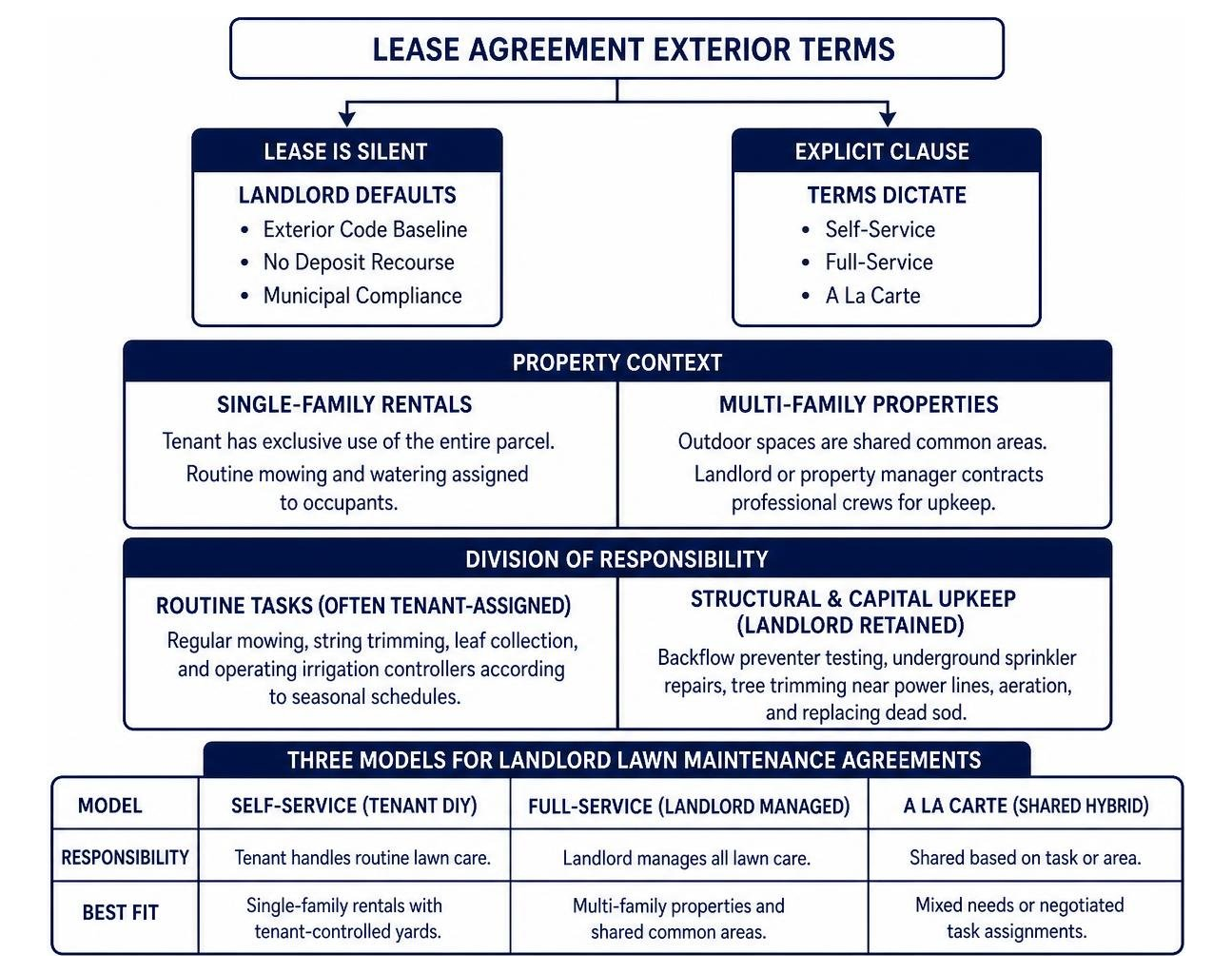
The lease should decide who handles the yard. If it does not mention lawn care, the landlord generally remains responsible for keeping the exterior maintained and compliant with local rules. For a single-family rental, landlords often assign routine work such as mowing, weeding, watering, and leaf cleanup to the tenant while keeping major work – irrigation repairs, tree care, and landscape replacements – under landlord control.
In duplexes and apartments, the landlord or property manager usually maintains shared grounds. The simplest way to prevent conflict is to list each task, the expected standard, who supplies equipment, and what happens if the work is missed.
A tidy lawn does more than look good. It protects curb appeal, helps avoid city or HOA notices, and gives tenants a better reason to renew. Whether you use tenant self-service, full-service landscaping, or a shared plan, clarity beats assumptions every time.
Landlord lawn maintenance helpful reading:
Legal Baselines: Who Is Responsible When the Lease Is Silent?
When a residential tenancy agreement is completely silent regarding exterior upkeep, statutory and common-law principles place the default burden directly on the property owner. You cannot legally penalize a tenant or withhold funds from their security deposit for failing to mow grass or pull weeds if that duty was never explicitly assigned to them in writing.
Local municipalities enforce strict exterior property standards and weed abatement ordinances. In cities throughout the Salt Lake Valley, Sandy, Draper, and Riverton, code enforcement officers issue citations for overgrown weeds exceeding statutory height thresholds (typically 6 inches) directly to the deeded owner of record, not the occupant.
According to a comprehensive analysis of rental yard care legal baselines, courts consistently rule that silence in a contract defaults to the property owner maintaining structural, environmental, and exterior standards. Relying on unwritten verbal understandings almost always leads to dismissed claims in small-claims court.
Single-Family Rentals vs Multi-Family Properties
The physical structure of a rental dictates operational feasibility:
- Single-Family Homes: The tenant enjoys exclusive use of the entire parcel, including the front, back, and side yards. Assigning routine mowing and watering to single-family occupants is standard practice.
- Multi-Family Properties (Duplexes, Triplexes, Apartments): Outdoor spaces serve as shared common areas. You cannot expect a tenant in Unit A to mow the shared courtyard while the tenant in Unit B watches from their window. In multi-family environments across the Wasatch Front, the landlord or property manager must contract professional crews to service common grounds and maintain curb appeal.
Division of Routine Tasks vs Structural Upkeep
To prevent disputes, leases must distinguish between routine cosmetic maintenance and structural/capital landscaping upkeep:
- Routine Tasks (Often Tenant-Assigned): Regular mowing, string trimming along fences, seasonal leaf collection, and operating irrigation controllers according to seasonal schedules.
- Structural & Capital Upkeep (Landlord Retained): Backflow preventer testing, fixing underground sprinkler pipe fractures, trimming mature tree branches near power lines, aeration, and replacing dead sod.
Understanding how residential maintenance services protect property structure helps property owners separate cosmetic tenant duties from critical structural infrastructure that protects asset value.
Three Models for Landlord Lawn Maintenance Agreements
Managing outdoor upkeep across rental properties requires choosing a clear contractual framework.
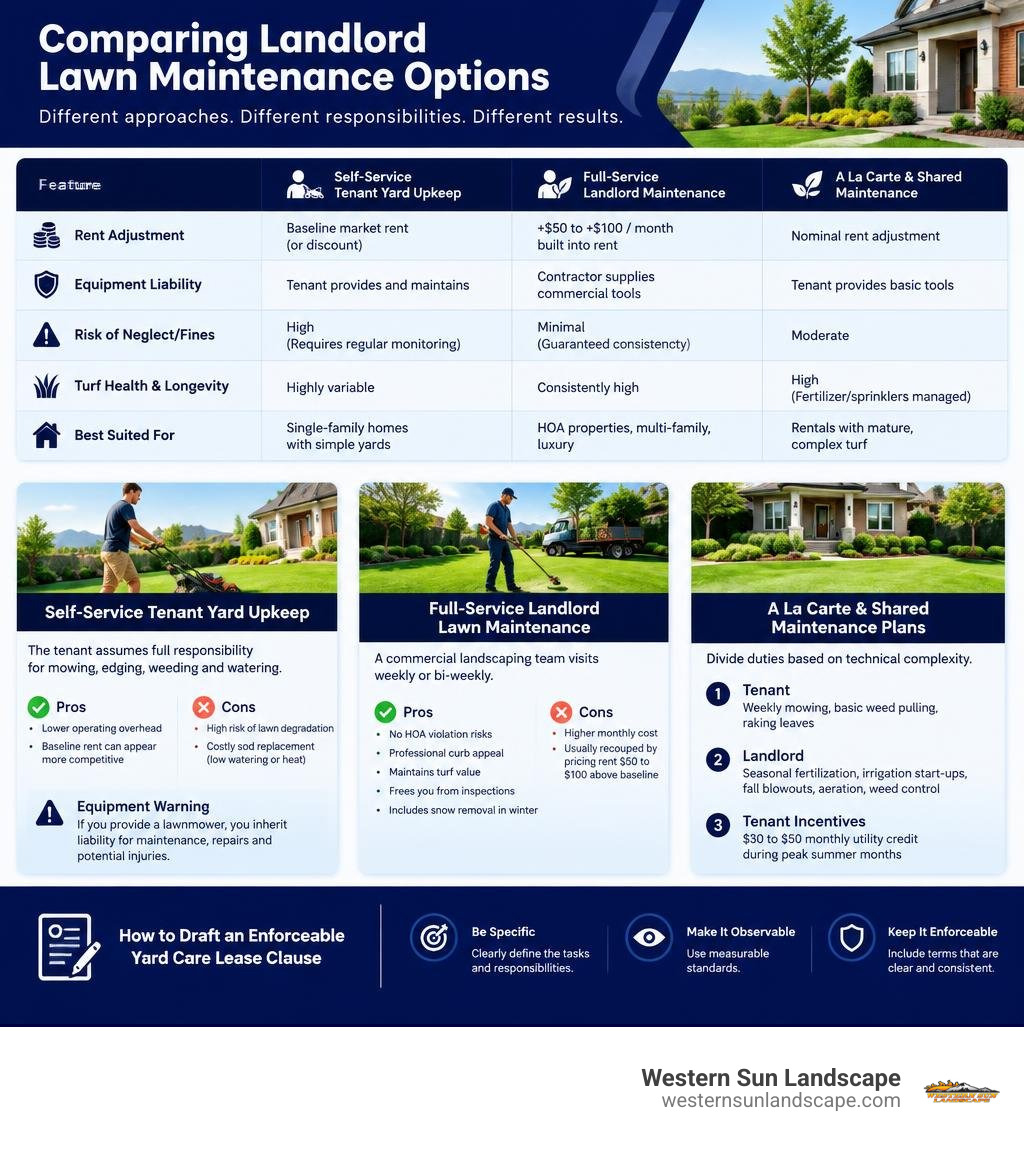
| Feature / Metric | Self-Service (Tenant DIY) | Full-Service (Landlord Managed) | A La Carte (Shared Hybrid) |
|---|---|---|---|
| Primary Responsibility | Tenant handles all routine tasks | Landlord hires professional crew | Split (Tenant mows, Landlord treats) |
| Rent Adjustment | Baseline market rent (or discount) | +$50 to +$100 / month built into rent | Nominal rent adjustment |
| Equipment Liability | Tenant provides and maintains | Contractor supplies commercial tools | Tenant provides basic tools |
| Risk of Neglect/Fines | High (Requires regular monitoring) | Minimal (Guaranteed consistency) | Moderate |
| Turf Health & Longevity | Highly variable | Consistently high | High (Fertilizer/sprinklers managed) |
| Best Suited For | Single-family homes with simple yards | HOA properties, multi-family, luxury | Rentals with mature, complex turf |
Self-Service Tenant Yard Upkeep
Under a self-service model, the tenant assumes full responsibility for mowing, edging, weeding, and watering.
- Pros: Lower direct operating overhead for the owner; baseline rent can appear more competitive on listings.
- Cons: High risk of lawn degradation. Even 30 days of improper watering during hot July weather in South Jordan or Herriman can destroy turf, costing $800 to $2,000+ in sod replacement.
- Equipment Warning: If you provide a lawnmower, you inherit liability for maintenance, repairs, and potential injuries. Requiring tenants to provide their own equipment or specifying strict tool maintenance terms is critical.
Full-Service Landlord Lawn Maintenance
With a full-service plan, the owner contracts a commercial landscaping team to visit weekly or bi-weekly.
- Pros: Eliminates HOA violation risks, guarantees professional curb appeal, maintains turf value, and frees landlords from micromanaging yard inspections. In Utah winters, full-service contracts easily integrate automated snow removal for walkways and driveways.
- Cons: Higher monthly operating line item, though usually recouped by pricing rent $50 to $100 above baseline.
Learning why professional house maintenance services save property owners money makes it obvious that routine preventative care costs far less than fixing ruined turf, clogged gutters, and failed irrigation systems.
A La Carte and Shared Maintenance Plans
The hybrid model divides duties based on technical complexity:
- Tenant: Performs basic, frequent cosmetic tasks (weekly mowing, basic weed pulling, raking leaves).
- Landlord: Manages technical, high-impact treatments (seasonal fertilization, spring irrigation start-ups, fall blowouts, aeration, and weed control applications).
- Tenant Incentives: Some landlords provide a $30 to $50 monthly utility credit during peak summer months to offset the water bill required to keep turf green.
How to Draft an Enforceable Yard Care Lease Clause
Vague phrases like “tenant shall keep the yard in good condition” are legally unenforceable. What a college-student tenant considers “good condition” rarely matches the standards of an HOA board in Draper or Lehi.
According to proven drafting guidelines for rental landscaping clauses, enforceable contracts must provide specific, observable, and measurable criteria.

Setting Measurable Standards and Equipment Rules
Your yard care addendum should define clear rules:
- Turf Height Limit: “Lawn grass must be mowed regularly and maintained at a height not to exceed 3.5 inches.”
- Watering Schedules: “Tenant agrees to water the lawn 3 days per week between 10:00 PM and 6:00 AM, complying with local municipal water conservation rules.”
- Weed Abatement: “Tenant must keep flower beds, gravel strips, and paved walkways free of weeds exceeding 2 inches in height.”
- Irrigation Reporting: “Tenant must report broken sprinkler heads, dry patches, or pooling water within 48 hours of discovery.”
Notice-to-Cure Framework and Back-Charging Terms
Your lease must contain an explicit remedy clause allowing you to correct neglect and bill the tenant:
- Written Notice to Cure: If the lawn is neglected, send a formal written notice with dated photos granting a specific remediation window (typically 7 to 14 days).
- Right to Remedy: State that if the tenant fails to correct the violation within the cure window, the landlord has the right to dispatch a professional landscaping crew to remediate the property.
- Back-Charging: Specify that the third-party invoice will be billed directly to the tenant as “additional rent” due on the next billing cycle.
Enforcing Standards, Managing Neglect, and Security Deposits
Landscaping disputes account for a large portion of security deposit disagreements in small-claims court. Protecting your business requires a complete paper trail.

Best Practices for Landlord Lawn Maintenance in HOA Communities
If your rental property is located within an HOA community in South Jordan, Herriman, or Sandy, the stakes are elevated. HOAs issue rapid fines for brown patches, missed mowings, and flowerbed weeds—and those fines legally attach to the homeowner, not the tenant.
For HOA properties, full-service landlord maintenance is almost always the best approach. Relying on tenant self-service in an HOA often leads to surprise notices and costly fines. Implementing commercial lawn care strategies for high-standard properties ensures pristine presentation and prevents HOA compliance headaches.
Handling Move-Out Inspections and Lawn Damage Deductions
To legitimately withhold funds from a tenant’s security deposit for dead turf or overgrown yards at move-out, you must meet three strict legal criteria:
- Move-In Baseline Evidence: Detailed, timestamped move-in inspection photographs showing the healthy condition of the lawn, flowerbeds, and sprinkler heads when the tenant took possession.
- Documented Breach During Tenancy: Copies of written notices to cure sent during the tenancy showing ongoing neglect rather than sudden end-of-lease seasonal dormancy.
- Itemized Third-Party Receipts: Invoices from a licensed landscaping contractor detailing the specific labor and materials (e.g., aeration, topsoil, overseeding, or sod installation) required to restore the yard to its baseline condition beyond normal wear and tear.
Frequently Asked Questions About Rental Lawn Care
Can a landlord deduct lawn replacement costs from a security deposit?
Yes, but only if you have solid documentation. You must show that the lease assigned routine yard care to the tenant, provide move-in photos proving the lawn was healthy at the start of the tenancy, show proof of written notices to cure sent during periods of neglect, and provide itemized contractor invoices for the repair work. You cannot charge a tenant to replace sod that died due to pre-existing irrigation line breaks or natural drought restrictions.
How does including lawn care impact monthly rental pricing?
Properties offering full-service maintenance routinely command a $50 to $100 monthly rental premium. Renters are often happy to pay slightly higher rent to avoid spending their weekends mowing lawns or buying yard tools. Landlords benefit from preserved turf health and fewer tenant disputes.
What happens if an HOA fines the rental for yard neglect?
Because the HOA agreement is with the property owner, all violation notices and fines arrive in your mailbox. When your lease includes clear HOA compliance clauses, you can pass these fines directly to the tenant as an added balance, issue a lease violation notice, and dispatch a professional lawn team to bring the property back into compliance immediately.
Conclusion
Managing rental property landscaping does not have to be stressful. By establishing clear written lease terms, setting observable maintenance standards, choosing an agreement model that fits your property, and keeping thorough photographic records, you can protect your investment and maintain strong relationships with your tenants.
For rental owners across the Salt Lake Valley, Sandy, Draper, Riverton, Herriman, and surrounding Wasatch Front communities, partnering with seasoned landscape professionals ensures worry-free exterior management. Explore our professional residential property maintenance solutions at Western Sun Landscape to keep your rentals healthy, compliant, and thriving season after season.


