
Landlord Maintenance Costs: What to Expect and How to Prepare
How Much Should Landlords Budget for Maintenance?
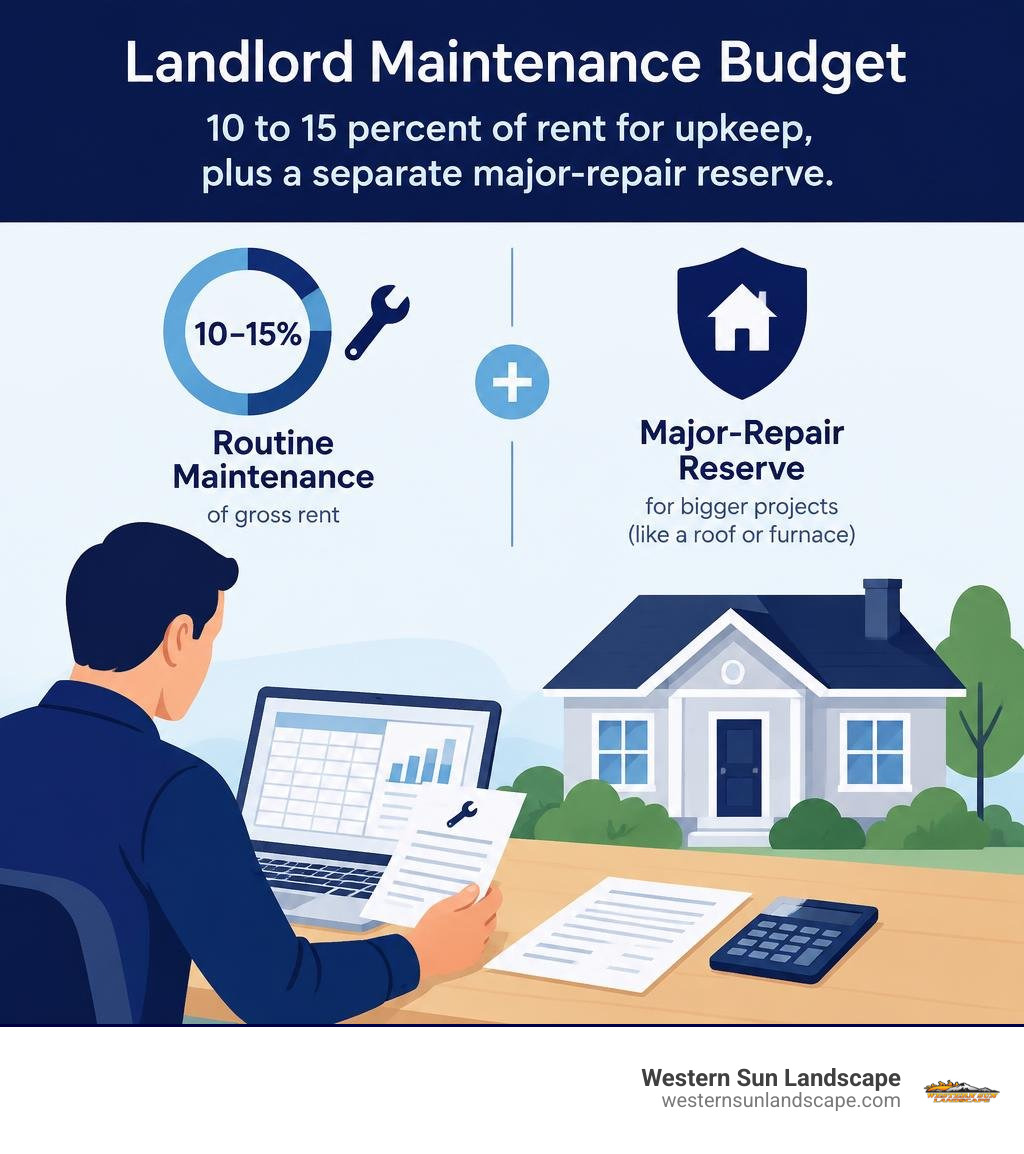
Start by setting aside 10% to 15% of gross rent each year for routine maintenance. Check that figure against 1% of the property’s value, then adjust for its age, condition, and known repairs. Keep a separate reserve for major replacements, such as a roof or furnace. These are planning rules, not promises about what you will spend.
A rental may need little work one month and an urgent repair the next. Budgeting for both helps protect your cash flow without putting off work that could become more costly.
Basic landlord maintenance costs glossary:
Understanding Average Landlord Maintenance Costs and Budget Benchmarks
Every landlord discovers sooner or later that maintenance is the single most unpredictable operating expense on the balance sheet. Unlike fixed mortgage payments or predictable insurance bills, repair requests arrive without warning: a water heater fails on a freezing January night in Sandy, or a central AC compressor gives up during a scorching July heatwave across the Salt Lake Valley.
Industry data confirms what experienced rental owners know by heart. According to comprehensive rental property maintenance cost statistics, the median rental property spent $1,600 per unit on maintenance and repairs, consuming roughly 8.0% of annual gross rent receipts and accounting for 42.1% of all non-tax operating expenses. However, because repair costs can spike unpredictably, the mean spend reached $2,782 per unit—pulled upward by emergency repairs and aging mechanical systems.
To keep your investment profitable across communities from Draper and Riverton to Lehi and Alpine, you need clear budgeting frameworks. The table below outlines how common planning rules compare against real-world property demands.
| Budgeting Rule / Method | Calculation Method | Typical Annual Range (Per Unit) | Best Suited Property Profile | Accuracy Limitations |
|---|---|---|---|---|
| 1% Property Value Rule | 1% of total market value per year | $2,500 – $6,000+ | Mid-age single-family homes (10–25 years old) | Distorts in high-value appreciation markets |
| 10% – 15% Gross Rent Rule | 10–15% of total annual rent collected | $1,800 – $3,600 | Standard suburban rentals & multi-unit properties | Underfunds older properties with low historical rents |
| Per-Door Benchmark | Fixed target based on unit count | $900 – $1,200 (Multifamily) / $1,800+ (Single-Family) | Portfolios, duplexes, and multi-family communities | Needs adjustment for older independent systems |
| Age-Adjusted Model | 0.5% (New) to 2.0%+ (30+ Years) of value | $1,000 – $6,000+ | Any property evaluated by physical system age | Requires regular on-site condition audits |
The 1% Rule vs. 10-15% Rent Rule: How Accurate Are Common Formulas?
The two most common formulas landlords rely on are the 1% rule and the 10% to 15% gross rent rule. While both provide a fast starting point, neither is foolproof on its own.

The 1% rule states that you should budget 1% of the property’s total market value every year for maintenance. On a $450,000 single-family home in South Jordan or West Jordan, that amounts to $4,500 annually. For properties built between 10 and 20 years ago in decent structural condition, this formula provides a realistic cushion. However, the rule struggles at the extremes:
- New construction (under 10 years): Often requires only 0.5% to 0.75% of value, meaning a 1% budget over-allocates operating capital.
- Older properties (30+ years): Frequently require 1.5% to 2.0% or more, meaning the 1% baseline leaves owners dangerously exposed when foundational systems wear out.
- High-appreciation markets: In rapidly growing corridors across Utah where home valuations rise quickly, a home’s structural maintenance needs do not automatically climb just because local property values doubled.
The 10% to 15% gross rent rule links repairs directly to your monthly cash flow. If a home in Cottonwood Heights rents for $2,400 per month ($28,800 annually), a 10% to 15% allocation earmarks $2,880 to $4,320 per year for upkeep. This method helps maintain cash-flow discipline, but it can fall short on older homes where rental yields are lower relative to the age of the structure and mechanical equipment.
What Drives Landlord Maintenance Costs by Property Age and Type?
Property structure, scale, and age are the primary drivers of maintenance expenditures. Single-unit rental homes incur higher per-unit maintenance costs (median $1,800 per unit) than large multifamily complexes with 50+ units ($873 per unit). Single-family assets carry standalone roofs, extensive yards, dedicated driveways, and independent HVAC systems that cannot spread replacement costs across multiple rent-paying doors.
Age plays an even more significant role:
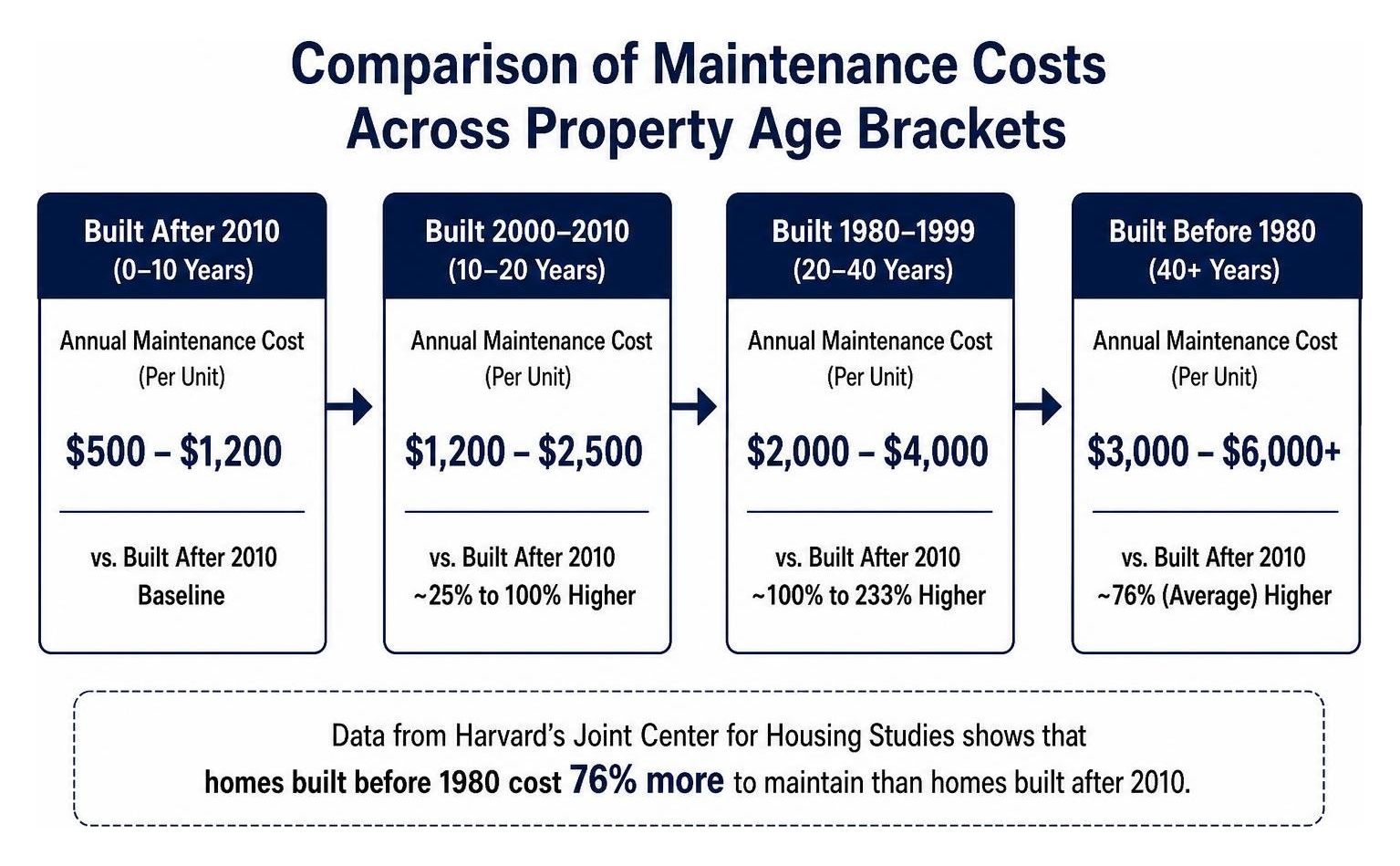
Data from Harvard’s Joint Center for Housing Studies shows that homes built before 1980 cost 76% more to maintain than homes built after 2010. While a new build in Herriman might average $500 to $1,200 annually for minor fixes, a classic home in Holladay or older Salt Lake neighborhoods often demands $3,000 to $6,000+ per unit as plumbing stacks, electrical panels, and roofing shingles reach the end of their design lifespans.
Legal Maintenance Responsibilities: Landlord vs. Tenant Duties
Navigating rental upkeep requires a clear distinction between legal obligations and resident responsibilities. State and local statutes define the minimum physical standards a rental property must meet before and during a tenancy.
Under standard Utah landlord-tenant rights, rental agreements carry an implied warranty of habitability. This legal requirement obligates property owners to provide safe, sanitary, and functional living conditions regardless of lease language.
Habitability Standards, Structural Repairs, and Urgent Fixes
Landlords are legally obligated to maintain essential structural components and vital utilities throughout the tenancy:
- Weatherproofing and structural integrity: Roofs, exterior walls, foundations, windows, and entry doors must keep water and outside elements out.
- Plumbing and sanitation: Properties must deliver continuous running hot and cold water, sanitary drain lines, and functional toilet fixtures.
- Heating and electrical infrastructure: Safe, operational heating systems capable of maintaining healthy indoor temperatures, alongside code-compliant electrical wiring and panels.
- Health and safety compliance: Operational smoke alarms, carbon monoxide detectors, and immediate remediation of environmental hazards such as sewage overflows or structural dampness.
When a vital utility or structural component fails, prompt remediation is required. A broken furnace in freezing winter weather or an active plumbing leak that damages ceilings is considered an emergency requiring immediate action to prevent severe property destruction and legal liability.
Tenant Upkeep and Damage Allocations
While owners bear responsibility for capital assets and natural wear and tear, tenants are responsible for day-to-day cleanliness and damage caused by misuse:
- Tenant duties: Keeping premises sanitary, promptly disposing of garbage, operating electrical and plumbing fixtures properly, replacing standard interior light bulbs, and testing smoke detector batteries.
- Tenant negligence vs. normal wear: A worn carpet in a high-traffic hallway after four years is normal wear and tear. A burn mark, pet stain, or broken window caused by rough handling constitutes tenant damage. Landlords may deduct reasonable repair expenses for tenant damage from the security deposit, provided repair logs and itemized receipts are maintained.
Routine Repairs vs. Capital Improvements: Tax Rules and Reserve Planning
Handling repairs properly requires understanding their tax implications. The Internal Revenue Service (IRS) draws a clear line between immediate operating deductions and multi-year capital improvements.
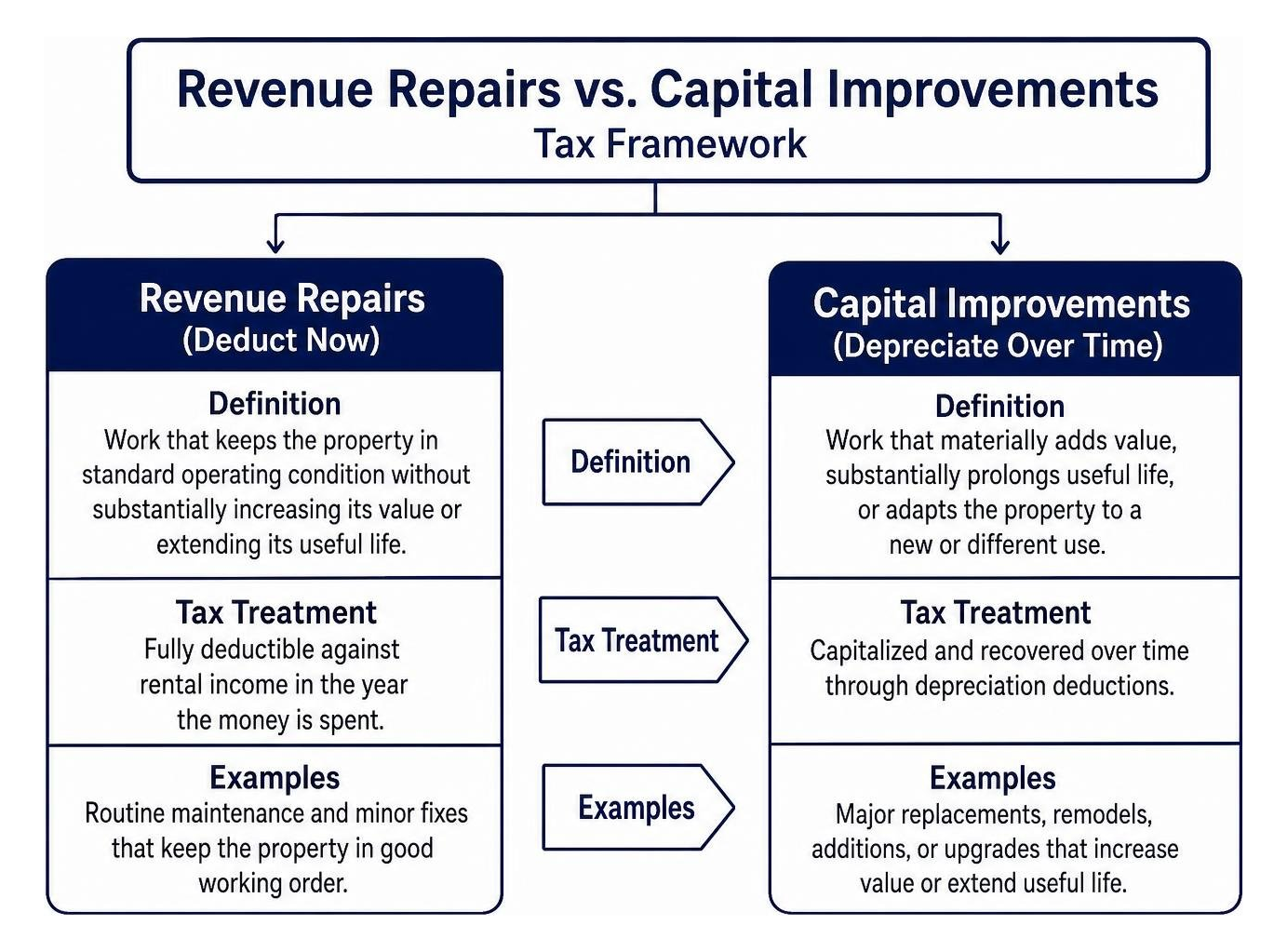
Revenue Expenses vs. Depreciable Capital Improvements
Routine Repairs (Revenue Expenses):
- Definition: Work that keeps the property in standard operating condition without substantially increasing its value or extending its useful life.
- Tax Treatment: Fully deductible against rental income in the tax year the money is spent.
- Examples: Patching drywall, servicing an air conditioner, clearing blocked drains, repainting interior walls between tenants, or replacing a broken windowpane.
Capital Improvements (CapEx):
- Definition: Work that results in a betterment, restoration, or adaptation of the asset to a new use.
- Tax Treatment: Cannot be fully deducted in the current year. Instead, the cost is capitalized and depreciated over its recovery period (generally 27.5 years for residential rental property structures, or shorter timelines for qualifying appliances and site improvements).
- Examples: Installing a complete new roof, replacing the entire HVAC system, repaving a driveway, or undertaking an extensive kitchen renovation. Under IRS Safe Harbor rules (such as the de minimis safe harbor), qualifying expenses under certain dollar thresholds may be expensed immediately if documented properly.
Building Operating and CapEx Reserves
To prevent surprise capital expenses from destroying your annual cash flow, establish two dedicated reserve funds in separate accounts:
- Operating Reserve: Maintain 10% to 15% of annual gross rent (or 2 to 3 months of baseline operating costs) to cover day-to-day service calls, seasonal tune-ups, and minor plumbing repairs.
- CapEx Replacement Reserve: Set aside $200 to $500 per unit per year for single-family rentals and townhomes to fund long-term system replacements (such as roofs, water heaters, and furnaces).
With 90.2% of rental properties nationwide reporting zero capital reserves, landlords who consistently fund these accounts avoid taking on high-interest debt when major systems eventually fail.
Most Common Rental Repairs and Preventive Management
Emergency repairs often cost two to four times more than scheduled, proactive maintenance. When an asset experiences deferred upkeep, minor issues quickly escalate into complex restoration jobs.
Investing in preventive residential maintenance services preserves asset value, keeps small mechanical defects from causing structural damage, and keeps tenants satisfied.
High-Cost Systems: HVAC, Plumbing, and Roofing
Three major building components account for the vast majority of emergency repair bills and capital expenses:
- HVAC Systems: Heating and cooling components represent one of the largest seasonal expense drivers. In extreme weather, service calls surge by 20% to 40%. A routine furnace tune-up costs $120 to $200, whereas an emergency compressor failure or full system replacement runs anywhere from $4,000 to $9,000+.
- Plumbing and Sewer Lines: Plumbing is the most frequent major component requiring repair (affecting 28% of properties that report capital work). Small leaks beneath kitchen sinks rot subflooring, while main line tree root intrusions can trigger sewer backups that cost thousands of dollars in water remediation.
- Roofing and Exterior Drainage: Roof work is less frequent (7% of capital spenders), but it is tied for the most expensive repair, with a median cost of $5,000 for partial repairs and well over $10,000 to $18,000 for full replacements. Clogged rain gutters and poor exterior grading cause water to pool along foundation perimeters, creating basement moisture issues.
Proven Strategies to Lower Landlord Maintenance Costs Over Time
Landlords can keep ongoing repair costs manageable by implementing several proven operational habits:
- Enforce Seasonal Checklists: Flush water heaters annually to remove mineral scale, service HVAC systems each spring and autumn, and clean gutters before winter storms arrive.
- Maintain Landscaping and Site Drainage: Overgrown tree roots fracture sewer pipes, while unkempt branches damage roofs and siding during high winds. Utilizing a professional house maintenance service or structured exterior care plan keeps exterior drainage paths clear and protects exterior investments.
- Conduct Bi-Annual Inspections: Walk through properties every 6 to 12 months with proper advance notice to catch leaking supply lines, failing caulking, and unreported tenant damage before they escalate.
- Deploy Digital Reporting Portals: Provide residents with an easy, timestamped portal for maintenance requests. Encouraging tenants to report dripping faucets immediately prevents rotting cabinets and drywall damage.
Key Maintenance Metrics and Impact on Rental Cash Flow
Treating rental property maintenance as an active discipline directly improves your Net Operating Income (NOI). Tracking key performance indicators (KPIs) allows you to spot underperforming assets before they erode portfolio returns.
Performance Benchmarks: Cost Per Door and Work Order Frequency
Professional asset managers monitor core operational benchmarks to identify whether properties are overspending or suffering from deferred maintenance:
- Cost Per Door: Professional multifamily portfolios average $900 to $1,200 per door annually, while single-family portfolios generally range between $1,200 and $2,500 per door depending on property age.
- Work Order Volume: Well-managed properties experience between 1.2 and 2.2 work orders per unit per year. If a single rental generates four or more calls annually, it usually signals an aging appliance or deferred plumbing issue that requires a complete system replacement rather than ongoing piecemeal patches.
- Preventive vs. Reactive Ratio: Target a ratio of 60% preventive work to 40% reactive repairs. Properties operating with an 80%+ reactive ratio spend significantly more over time on contractor rush charges and emergency diagnostics.
The True Financial Impact of Tenant Turnover
Poor maintenance coordination is one of the leading causes of tenant turnover. When maintenance calls are ignored or handled with temporary patches, quality residents choose to move at the end of their leases.
Turnovers are exceptionally expensive. Between make-ready repairs, fresh paint, deep carpet cleaning, vacancy losses, and leasing commissions, the average multifamily or single-family unit turnover costs roughly $4,000 per turn. Maintaining high property standards protects tenant retention rates, minimizes vacancy loss, and safeguards annual cash flow.
Frequently Asked Questions About Landlord Maintenance Costs
How much should a landlord set aside for maintenance each year?
A reliable baseline is to budget 10% to 15% of annual gross rent or 1% of the property’s total market value for day-to-day upkeep. For newer properties (under 10 years old), annual maintenance often averages between $500 and $1,200 per unit. For properties older than 30 years, plan for $3,000 to $6,000+ per unit, and build a separate CapEx reserve fund of $200 to $500 per door annually to finance major system overhauls.
What is the difference between maintenance repairs and capital improvements for tax purposes?
Routine repairs restore a property to its normal operating condition without extending its overall lifespan—such as repainting a room between tenants, servicing an air conditioner, or repairing a leaky faucet. These are fully deductible against rental income in the year they occur. Capital improvements add significant value, extend the property’s useful life, or adapt space for new uses (such as installing a new roof or upgrading electrical service panels), requiring the expense to be capitalized and depreciated over multiple tax years.
Which maintenance tasks are legally the landlord’s responsibility?
Landlords are legally responsible for all repairs affecting the health, safety, and basic habitability of the rental property. This includes maintaining structural components, roof integrity, operational heating equipment, safe electrical systems, and working plumbing fixtures. Landlords must also address active water leaks and pest intrusions promptly. Tenants are responsible for keeping the interior clean, disposing of trash properly, and repairing damage resulting from tenant negligence or lease violations.
Conclusion
Managing rental property maintenance costs effectively is what separates profitable real estate investments from stressful money pits. By moving away from guesswork and adopting proven formulas—such as the 10% to 15% gross rent rule, age-adjusted budgeting, and separate CapEx reserve funds—you protect your cash flow and keep your properties in top condition year after year.
Routine preventive maintenance, thorough seasonal inspections, and responsive property care not only preserve your physical assets but also build strong tenant loyalty and cut expensive turnover costs.
At Western Sun Landscape, we bring over 45 years of local expertise to helping residential and commercial property owners maintain beautiful, functional properties throughout South Jordan, Sandy, Draper, Riverton, Herriman, Lindon, and the entire Wasatch Front. From full-season grounds maintenance to winter snow management and exterior site care, our dedicated teams keep your properties safe, compliant, and attractive. Contact us today to explore our comprehensive property maintenance services and protect your real estate investments for the long haul.


